
The Behavioral Health Services Act Overview
The Behavioral Health Services Act (BHSA) passed through Proposition 1 by the California voters on March 5, 2024. Proposition 1 includes two components: Behavioral Health Infrastructure Bond Act (AB 531) and the Behavioral Health Services Act (SB 326). BHSA updates how behavioral health funding is used to address mental health and substance use needs, BHSA focuses on housing, early intervention, and services for people with the most significant behavioral health challenges.
Page Contents (click to navigate)
- Frequently Asked Questions
- BHSA Infographics
- Local Data and Reports (Coming Soon)
- BHOATR (Coming Soon)
- Information Notices
- DHCS Webinars
- Additional Resources
Proposition 1
Behavioral Health Infrastructure Bond Act (AB 531):
Authorizes $6.4 billion to build or develop behavioral health housing and treatment facilities.
Behavioral Health Services Act (SB 326):
Aims to improve and expand behavioral health services and housing interventions for individuals with severe mental illness / emotional disorders (SMI / SED), & substance use disorders (SUD).
BHSA Populations
BHSA Target Populations
The target population for the Behavioral Health Services Act generally includes individuals who are dealing with significant behavioral health needs. This includes those with mental health conditions and / or substance use disorders.
BHSA Priority Populations
Eligible adults and older adults, or eligible children and youth who are:
- Chronically homeless or experiencing homelessness or at risk of homelessness
- In, or at risk of being in, the justice system
- Re-entering the community from prison or jail or youth correctional facility
- At risk of conservatorship or in the child welfare system
- At risk of institutionalization
Key Changes Under BHSA
- Investment in housing supports for people experiencing homelessness and behavioral health challenges.
- Dedicated funding for Full-Service Partnerships (FSPs), which provide intensive, coordinated services for individuals with the highest levels of need.
- Increased emphasis on early intervention and behavioral health services for children, youth, and young adults.
- New statewide investments in workforce development programs.
- Enhanced accountability, transparency, and outcome reporting requirements.
How BHSA Funding Supports Alameda County
- Mental health and substance use treatment
- Crisis services
- Outreach and engagement
- Housing related supports
- Services for children, youth, adults, older adults, and families.
- Programs designed to reduce behavioral health disparities and improve access to care.
BHSA Funding Breakdown
The Mental Health Services Act funding components will change under the Behavioral Health Services Act.
The Mental Health Services Act ends June 2026. The components of the Mental Health Services Act are:
Community Services & Supports (CSS), Prevention & Early Intervention (PEI), Innovation (INN), Workforce, Education & Training (WET), Capital Facilities/Technological Needs (CFTN)
The Behavioral Health Services Act begins on July 1, 2026. The components of the Behavioral Health Services Act are: Housing Interventions (30%), Full Service Partnerships (35%), Behavioral Health Services & Supports (35%) and State Administrative Funds (10%).
Of the total funds, Counties are allocated 90% of total funds. The State of California is allocated 10% of total funds. Within the State of California’s 10% of funds, here is the breakdown: 3% State Administrative funds managed by the Department of Health Care Services, 3% Workforce funds managed by the Department of Health Access and Information, 4% Prevention funds managed by the California Department of Public Health.
BHSA Implementation Dates
Please see below for Proposition 1 key milestones to implement the Behavioral Health Services Act (BHSA) (SB 326) and Behavioral Health Infrastructure Bond Act (AB 531).
Summer 2024
Bond applications for treatment sites open. Last CPPP begins under MHSA.
Winter 2024
Bond applications for supportive housing open. Last CPPP ends under MHSA.
Winter 2025
BHSA Fiscal and CPPP begins. First set of DHCS guidelines are due. Local decisions on FY25/26 budget.
Spring/Summer 2025
Bond money is awarded to cities, counties, tribal entities, and organizations across California. BHSA CPPP ends.
Summer 2026
All counties implement new 3-year comprehensive behavioral health services plan.
BHSA Integrated Plan
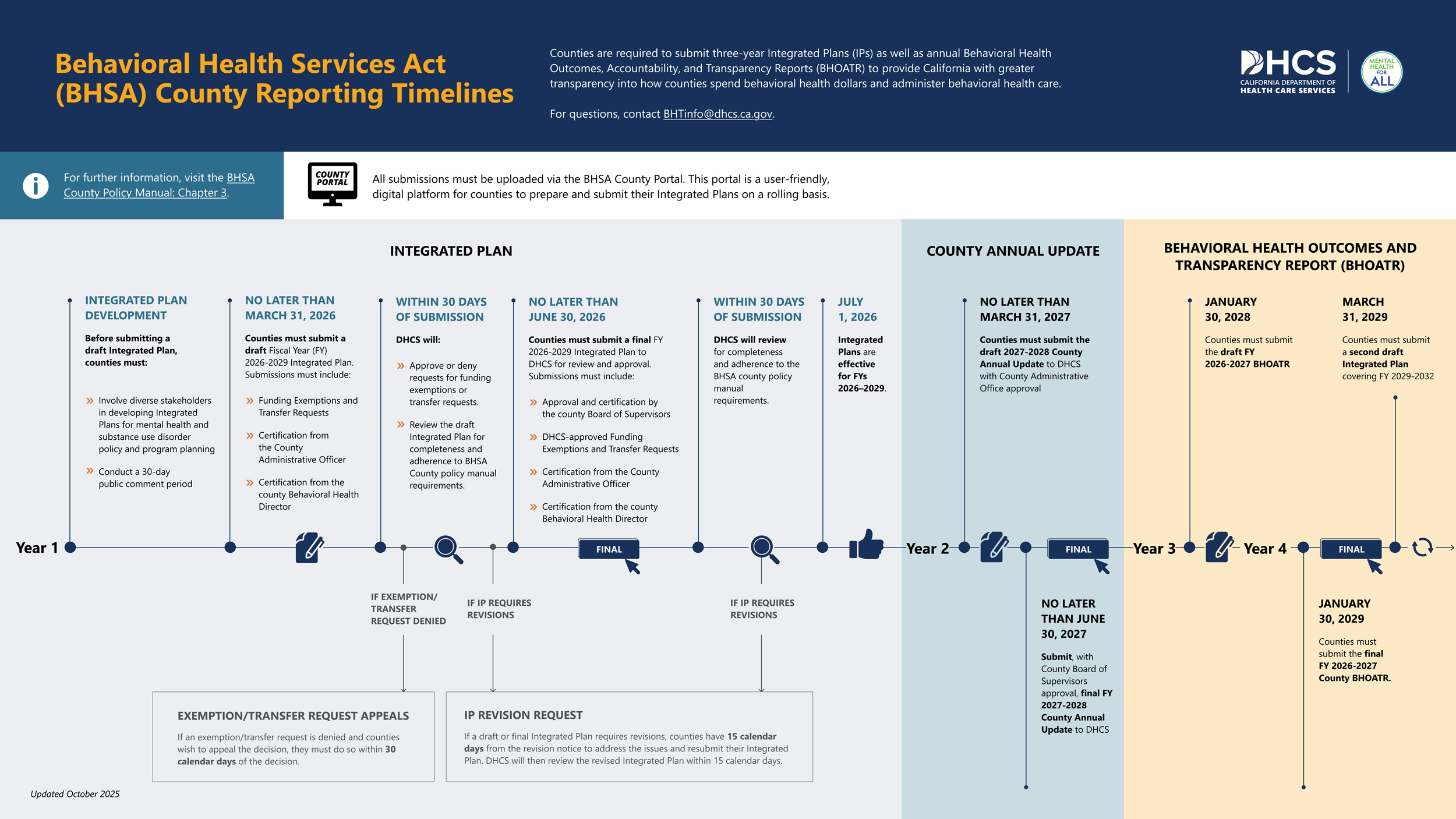
The County Integrated Plan is a three-year plan required by the Behavioral Health Services Act that outlines how counties will utilize various behavioral health funding sources (i.e., BHSA, 1991 and 2011 Realignment, federal grant programs, federal financial participation from Medi-Cal, opioid settlement funds, local funding, and other funding) to meet statewide and local outcome measures, reduce disparities, and address unmet needs along the Behavioral Health Care Continuum. The plan must be developed through a transparent community planning process, approved by the county board of supervisors, and submitted via the Department of Health Care Services (DHCS) web-based portal in accordance with Welfare and Institutions Code §5963.02.
Statewide Behavioral Health Goals
Alameda County is required to address six mandatory behavioral health goals, each county had to choose a seventh behavioral health goal, Alameda County selected overdoses. The Statewide Behavioral Health Goals will be used for transparency and planning and will focus on performance of county behavioral health and Medi-Cal Managed Care Plans. All performance measures will be stratified by key demographics, such as age group and race/ethnicity, and county behavioral health and Medi-Cal MCPs will be expected to address disparities in those measures in their Integrated Plans and Population Health Management strategy deliverables. Information on goal metrics will be available at Alameda County Profile – DHCS. This is an online tool from the State of California that shows behavioral health services and related data for every California county. This website supports transparency, accountability, and a clearer understanding of local behavioral health systems.
Below are the seven behavioral health goals:
Access to Care (Improve): Access to care is defined as the timely and appropriate use of health services to achieve the best possible health outcomes, encompassing all modalities of care. Improving access to care for Californians is essential to improving overall health outcomes.
Homelessness (Reduce): Addressing the increase in statewide homelessness is crucial to ensuring that unhoused individuals living with significant behavioral health needs have regular access to behavioral health treatment and have safe and stable housing where they can recover.
Justice Involvement (Reduce): This goal focuses on decreasing the number of adults and youth with behavioral health needs who become involved in the justice system. More than half of incarcerated individuals live with a behavioral health condition but often receive little or no treatment. After release, they face increased risks of overdose, suicide, and poor health outcomes. Building coordinated systems of care can prevent justice involvement and support better outcomes for those returning to the community.
Institutionalization (Reduce): Care provided in inpatient and residential (i.e., institutional) settings can be clinically appropriate and is part of the care continuum. The goal is to ensure institutionalization is only used, when necessary, for the appropriate duration, and never longer than clinically indicated.
Untreated Behavioral Health Conditions (Reduce): Untreated behavioral health conditions refer to behavioral health needs that have not been diagnosed or addressed through timely and appropriate care. Living with untreated behavioral health conditions can lead to worsening symptoms, diminished quality of life, unemployment, reduced educational attainment, homelessness, and higher risk of severe outcomes such as suicide or self-harm.
Overdoses (Reduce): Occurs when a toxic amount of a drug—or combination of drugs, including prescription medications, illegal substances, or alcohol—overwhelms the body’s ability to function.
Removal of Children from Home (Reduce): Refers to when children with a child welfare status are removed due to abuse and/or neglect. Providing early intervention and intensive behavioral health services to children, parents and other members of the family unit living with a behavioral health condition can help prevent family disruption and improve child welfare outcomes. With appropriate supports, children are less likely to be exposed to early childhood trauma and placed in foster care.
Resources
Frequently Asked Questions
BHSA Infographics
- Behavioral Health Settings Services and Funding-Sources
- Behavioral Health Continuum Infrastructure Program (BHCIP) Outcomes
- BHSA Funding Opportunities
- County Reporting Timelines
- MHSA vs. BHSA Funding
- BHSA Target Populations
- Behavioral Health Transformation Overview
- Statewide Behavioral Health Goals
- Metrics for Statewide Behavioral Health Goals
We look forward to hearing from the public and collaborating to make the Behavioral Health Services Act transition seamless and inclusive as possible. If you have any questions, you can email bhsa@acgov.org